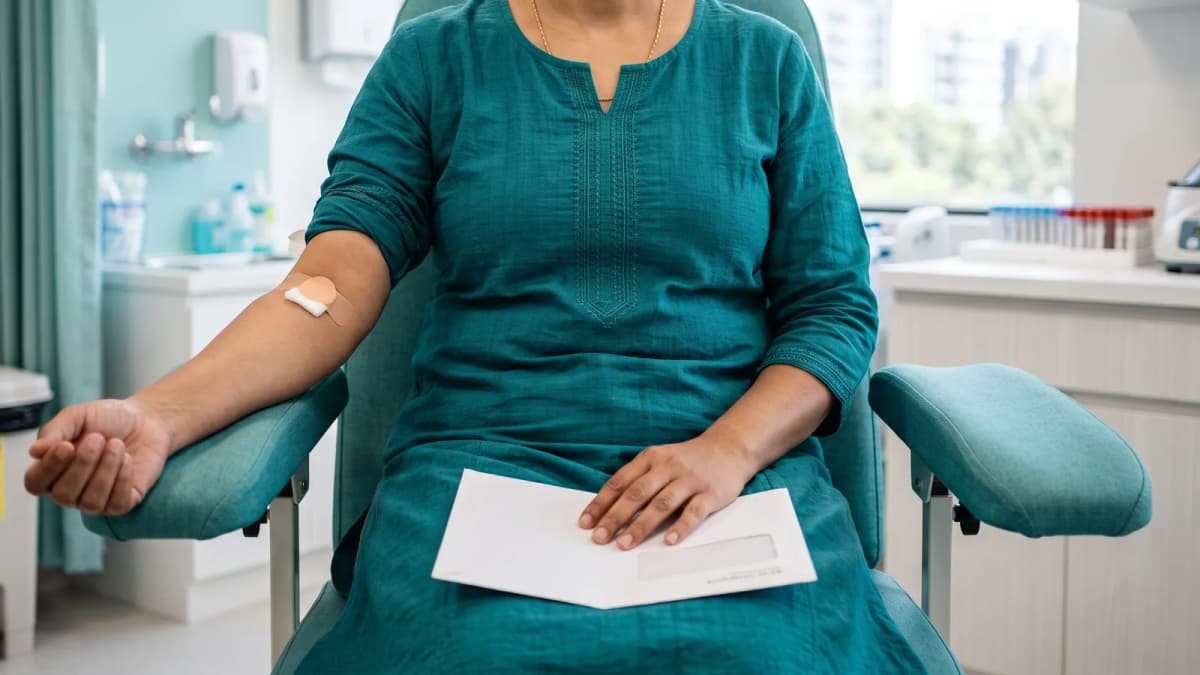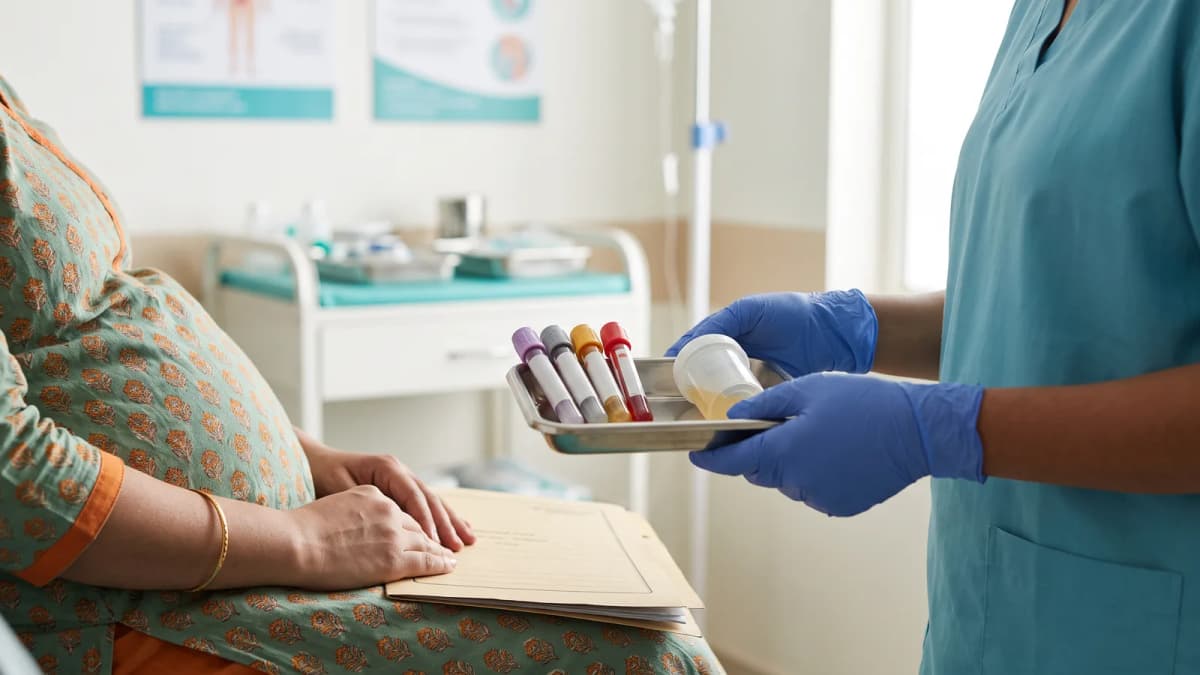


You are about three months pregnant. The first scan went well, and now your doctor has asked for a blood test called the double marker, to be done alongside a special scan. You have heard the word "risk" mentioned, and you would like to understand it before you go.
The double marker test in pregnancy is a routine screening test. Nearly every pregnant woman is offered it, and most results are reassuring. This guide explains what it measures, when it must be done, what it costs at our laboratory, and how to read a result calmly.
Our gynaecology department in Sonipat does the scan and the blood test in the same building, and the doctor who reads both is the same one looking after your pregnancy.
What is double marker test?
The double marker test, also called the dual marker test, is a blood test that measures two substances made by the pregnancy and the placenta. Their levels help estimate the chance that the baby has certain chromosomal conditions, mainly:
- Down syndrome (trisomy 21)
- Edwards syndrome (trisomy 18)
It is never used alone. It is combined with an ultrasound called the NT scan, which measures a small pocket of fluid at the back of the baby's neck, and with the mother's age. Together, these give a combined screening result.
The two markers, in plain words
The "double" in the name refers to the two substances measured.
Free beta-hCG is the pregnancy hormone, the same one a home pregnancy test detects. In pregnancies affected by Down syndrome it tends to be higher than usual.
PAPP-A (pregnancy-associated plasma protein A) is a protein made by the placenta. In affected pregnancies it tends to be lower than usual.
Neither number means anything on its own. Both depend heavily on exactly how many weeks pregnant you are, which is why the lab needs your dating scan. The software combines them with the NT measurement and your age to produce one combined figure, which is what your doctor discusses with you.
When the double marker test in pregnancy is done
Timing is the single most important thing about this test. It must be done between 11 and 14 weeks of pregnancy, at the same time as the NT scan.
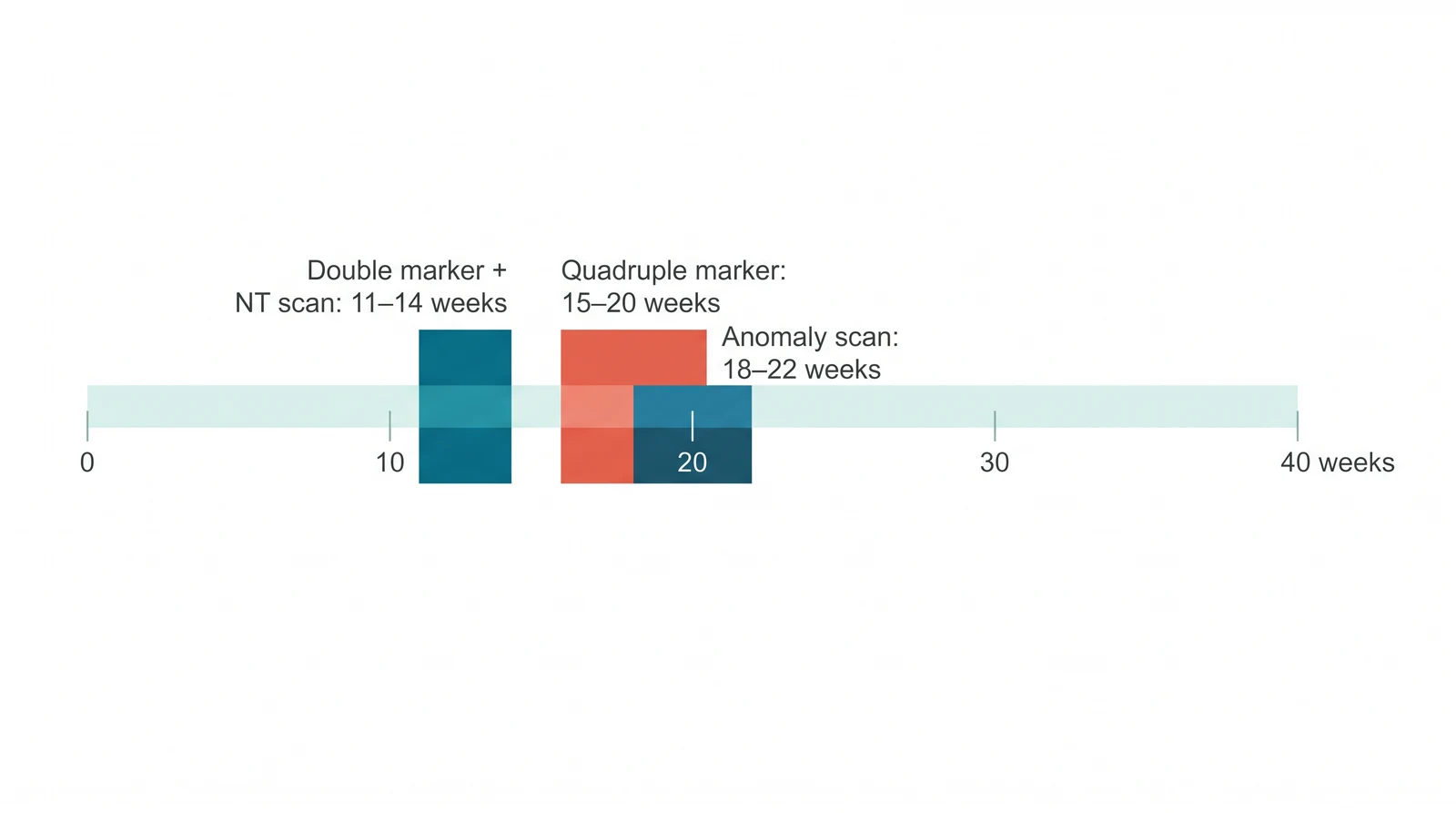
After 14 weeks the neck measurement is no longer reliable, and the double marker cannot be used. If that window is missed, the second-trimester option is the quadruple marker test, done between 15 and 20 weeks.
This is why your dating scan matters so much. It fixes how many weeks pregnant you are, so the screening can be booked on the right days. Our guide to the list of scans during pregnancy shows where this fits in the full schedule.
Double marker test price
The current double marker test price at our NABL-accredited laboratory is ₹2,200, as listed on our tests page. The NT scan is a separate ultrasound, done by our gynaecologist-radiologist.
You do not need to fast for this blood test. Bring your dating scan report, because the lab uses your exact pregnancy weeks to calculate the result.
How to read the result
This is where most worry comes from, so it is worth going slowly.
The result is not "positive" or "negative" in the way a pregnancy test is. It is a chance, written as a ratio such as "1 in 5,000" or "1 in 150".
- 1 in 5,000 means that out of 5,000 women with the same result, one would have a baby with the condition. That is a low chance.
- 1 in 150 is a higher chance, but it still means that 149 out of 150 such babies do not have the condition.
Labs draw a line, often around 1 in 250 to 1 in 300. Above that line the result is called "high chance" or "screen positive". Below it, "low chance".
Two things to hold on to:
- A high-chance result is not a diagnosis. Most women with a high-chance result go on to have a baby without the condition.
- A low-chance result is reassuring, not a guarantee. Screening finds most, but not all, affected pregnancies.
If the result is high chance
Your doctor will sit down with you and explain the options. There is no rush to decide anything in the room.
The options usually include:
- A more detailed blood test, such as a cell-free DNA test, which is more accurate but still a screening test.
- A diagnostic test, such as amniocentesis or chorionic villus sampling. These give a definite answer but carry a small risk of miscarriage.
- Choosing not to test further. This is also a valid choice.
Whatever you choose, you will be supported. The NHS guide to screening for Down's, Edwards' and Patau's syndromes and the ACOG guide to prenatal genetic screening tests explain these choices in the same careful way.
A word on the law
Sex determination is illegal in India. Our obstetric ultrasound is PC-PNDT compliant. No test or scan here will reveal the sex of your baby, and staff are legally obliged to refuse the question. Please do not ask.
Care at Saroj Hospital
Dr. Deepa Aggarwal, MBBS, DGO, DMRD, DNB (Radiology) sees patients in the gynaecology OPD every day, 10:00 AM–2:00 PM and 5:00–7:00 PM.
She is qualified in both obstetrics and radiology. That means the doctor who performs your NT scan is the same doctor who reads your double marker result and explains it to you. There is no gap between two departments and no waiting for a second opinion on your own scan.
If you are early in pregnancy and the screening is still ahead, our guide to your first pregnancy checkup explains everything that comes before it.
Frequently asked questions
Is the double marker test compulsory?
No. It is offered to every pregnant woman, and most choose to have it, but it is your choice. Your doctor will explain what it can and cannot tell you so you can decide.
Do I need to fast for the double marker test?
No. You can eat and drink normally. Bring your dating scan report so the lab can use your exact pregnancy weeks.
How long does the result take?
The blood test itself is processed quickly, but the combined risk calculation needs the NT scan measurement too. Your doctor will tell you when to expect the combined result.
Can the double marker test harm my baby?
No. It is a normal blood test from your arm. The NT scan is an ultrasound, which uses sound waves, not radiation.
Book an appointment
If you are approaching 11 weeks, book your NT scan and double marker together so they fall inside the right window. The scan, the blood test and the doctor who explains them are all in one place.
Book an appointment with the gynaecology OPD, or call reception on +91 96676 67011.
Medically reviewed by Dr. Deepa Aggarwal, MBBS, DGO, DMRD, DNB (Radiology), Saroj Hospital, Sonipat.
This article is general health information, not medical advice. For guidance about your own health, please consult a doctor.
Consult Dr. Deepa Aggarwal
Book a real slot online — confirmation is instant.