

She was 24, newly married, and had been told she had PCOS two years earlier. Her question was simple. "Should I wait until my PCOS is cured, or try now?" Her mother-in-law wanted a grandchild. Her own plan was to finish a course first. Everyone had an opinion, and nobody had given her a straight answer.
Questions like hers come up in our OPD almost every week. This guide explains what we tell women about the best age to get pregnant with PCOS: how age and PCOS work together, why waiting for a "cure" is usually the wrong plan, and when to ask for help.
Our gynaecology department in Sonipat does the scans, the blood tests and the consultation in one visit, with a woman doctor.
Two clocks running at once
Every woman's fertility is shaped by age. With PCOS, a second factor is added: ovulation, the monthly release of an egg, happens less often and less predictably.
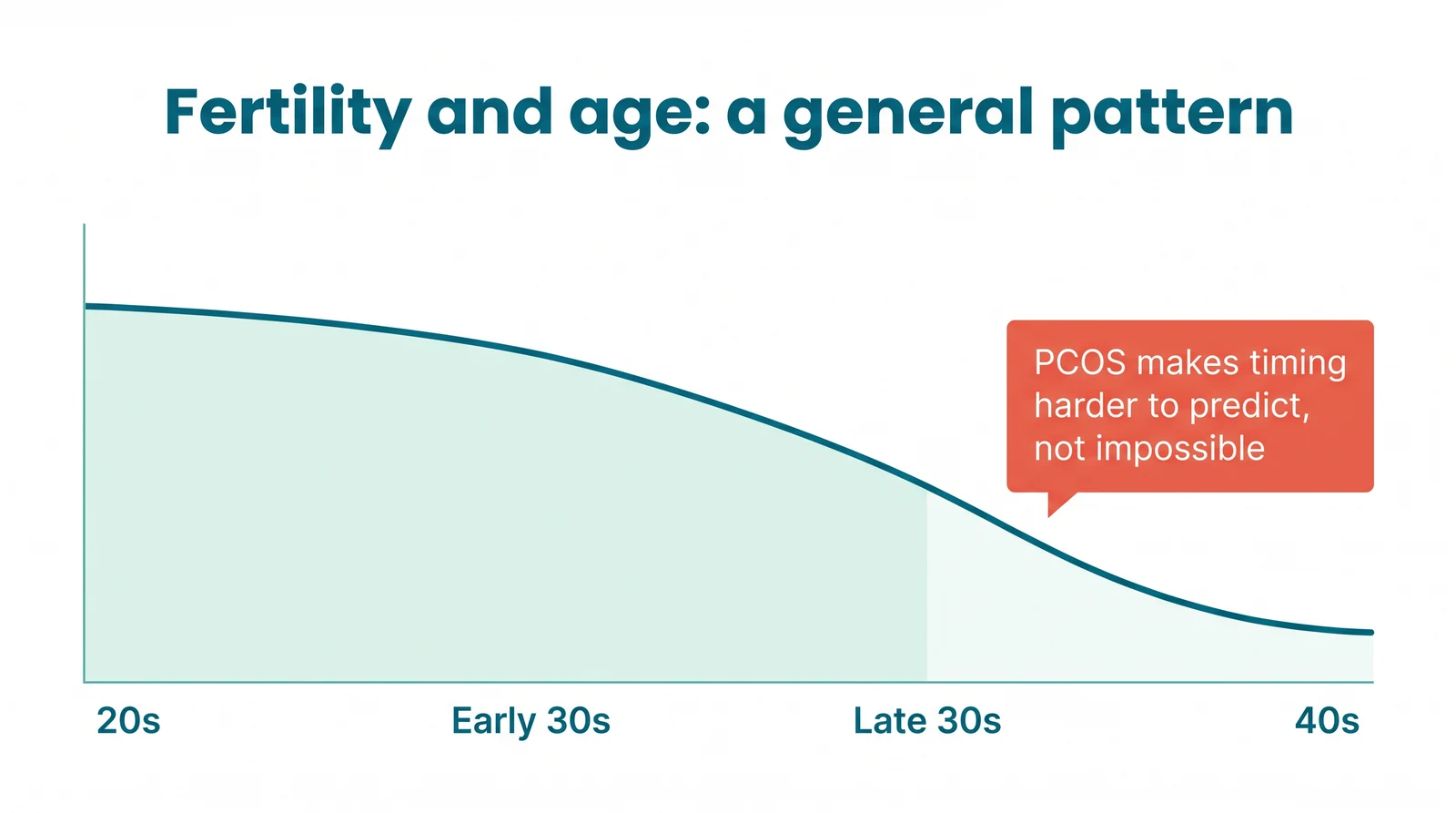
Age affects egg quality. Fertility starts to fall slowly in the early thirties and faster after about 35. This is true for every woman, with or without PCOS. The ACOG guide to having a baby after 35 explains why.
PCOS affects how often you ovulate. A woman with regular cycles has about twelve chances a year. A woman with PCOS may have far fewer. That is the main reason it can take longer.
Put together, the answer becomes clearer. Age decides how good each chance is. PCOS decides how many chances you get.
So what is the best age to get pregnant with PCOS?
There is no single magic age. But in general, trying in your twenties or early thirties gives the most room. You have good egg quality and time to sort out ovulation if it needs help.
That does not mean women in their late thirties cannot conceive with PCOS. Many do. It means there is less time to wait and see, so it is wise to see a gynaecologist sooner.
Interestingly, women with PCOS often have a larger egg reserve than average. Their AMH test is frequently high. So the issue is rarely running out of eggs. It is getting one released each month.
If you are already in your late thirties
Please do not read this page and panic. Plenty of women with PCOS have healthy babies at 37, 38 and beyond. The difference is that we would rather not spend a year waiting to see what happens.
In practice, that means an early visit. We check whether you are ovulating, look at the ovaries on ultrasound, test sugar and thyroid, and check your husband's semen report. If ovulation needs help, we usually start sooner rather than later. A few months saved at this age matters more than it would at 25.
Do not wait for PCOS to be "cured"
This is the most common mistake we see. PCOS is a long-term condition. It can be managed very well, but it does not simply disappear. Waiting for it to go away before trying can mean losing the years when fertility is best.
A better plan is to prepare and start trying at the same time.
Getting ready, whatever your age
Look at weight, gently. If you are above a healthy weight, losing even a small amount, around five per cent, often brings ovulation back. You do not need a dramatic diet. Our 7-day PCOS diet plan is built for Indian kitchens.
Start folic acid. It protects the baby's spine in early pregnancy. Ask your doctor to start it before you try.
Check your sugar and thyroid. PCOS raises the risk of diabetes. Thyroid problems can also affect cycles. Both are simple blood tests.
Track your cycles. Note the first day of each period. It shows your doctor how often you ovulate.
Bring your husband into it. In many couples, part of the reason for delay lies with the man. A simple semen test is part of a full check.
PCOS and pregnancy: what changes once you conceive
With PCOS and pregnancy, a few things deserve extra care. The risk of diabetes in pregnancy and high blood pressure is a little higher. This is not a reason to fear pregnancy. It is a reason to book early, keep regular check-ups, and have your sugar tested on time. Our guide to your first pregnancy checkup explains where that starts.
When to see a gynaecologist
Do not wait a full year if you have PCOS. See a doctor:
- Straight away if your periods are very irregular or absent
- After six months of trying if you are under 35
- Before you start trying if you are 35 or older
Treatment to help you ovulate is usually simple and often works. Our article on getting pregnant with PCOS explains the usual first steps. The NHS overview of PCOS and the NICHD's PCOS information describe the same approach.
Meeting Dr. Deepa Aggarwal
Dr. Deepa Aggarwal, MBBS, DGO, DMRD, DNB (Radiology) sees patients in the gynaecology OPD every day, 10:00 AM–2:00 PM and 5:00–7:00 PM.
She is qualified in gynaecology and radiology, so she can read your ovary scan herself in the same visit. Couples are welcome to come together. If the conversation at home is tense, a calm explanation from a doctor often helps everyone. Useful blood tests can be done here the same day. For example, the current price of an AMH test at our NABL-accredited lab is ₹2,000, as listed on our tests page.
Questions women ask us
Can I get pregnant naturally with PCOS?
Yes. Many women with PCOS conceive without any treatment, especially if their cycles are only slightly irregular. Others need simple tablets to help them ovulate. Very few need advanced treatment.
Is it harder to get pregnant with PCOS after 35?
It can be, because egg quality falls with age for everyone. PCOS adds irregular ovulation on top. That is why we suggest seeing a doctor before you start trying if you are over 35.
Should I lose weight before trying to conceive?
If you are above a healthy weight, a small, steady loss often helps ovulation return. But do not delay trying for months to reach a perfect number. You can work on both together.
Does PCOS go away after pregnancy?
No. PCOS usually continues after pregnancy, though some women find their cycles become more regular. Keeping a healthy weight and checking sugar every year remain important.
Book an appointment
If you have PCOS and are thinking about a baby, now or in a few years, book a consultation. A short visit today can save years of guessing.
Book an appointment with the gynaecology OPD, or call reception on +91 96676 67011.
Medically reviewed by Dr. Deepa Aggarwal, MBBS, DGO, DMRD, DNB (Radiology), Saroj Hospital, Sonipat.
This article is general health information, not medical advice. For guidance about your own health, please consult a doctor.
Consult Dr. Deepa Aggarwal
Book a real slot online — confirmation is instant.