Most people arrive with the same worry: will this mean an operation?
For most people, no. Kidney stones treatment medicine and plain water clear a good share of stones without anyone going near an operating theatre. What decides it is the size of the stone and where it has lodged. Not how much the pain frightened you.
This explains which stones pass on their own, which need help, what the procedures actually involve, and how long recovery takes. If you are still at the stage of working out whether you have a stone at all, start with the early signs. For assessment, our urology department in Sonipat has ultrasound and the laboratory in the same building.
What decides the treatment
Three things, in order:
Size. Stones under about 5 mm pass on their own in most cases. Between 5 and 10 mm it becomes less likely. Above 10 mm, passing spontaneously is uncommon.
Position. A stone sitting low in the ureter, near the bladder, has a much better chance of passing than one stuck higher up.
What it is doing. A stone causing no symptoms and no obstruction can sometimes simply be watched. One blocking urine flow cannot, whatever its size.
There is also a fourth factor people forget: whether the kidney is infected. A blocked, infected kidney is an emergency and changes the plan entirely.
Kidney stones treatment medicine
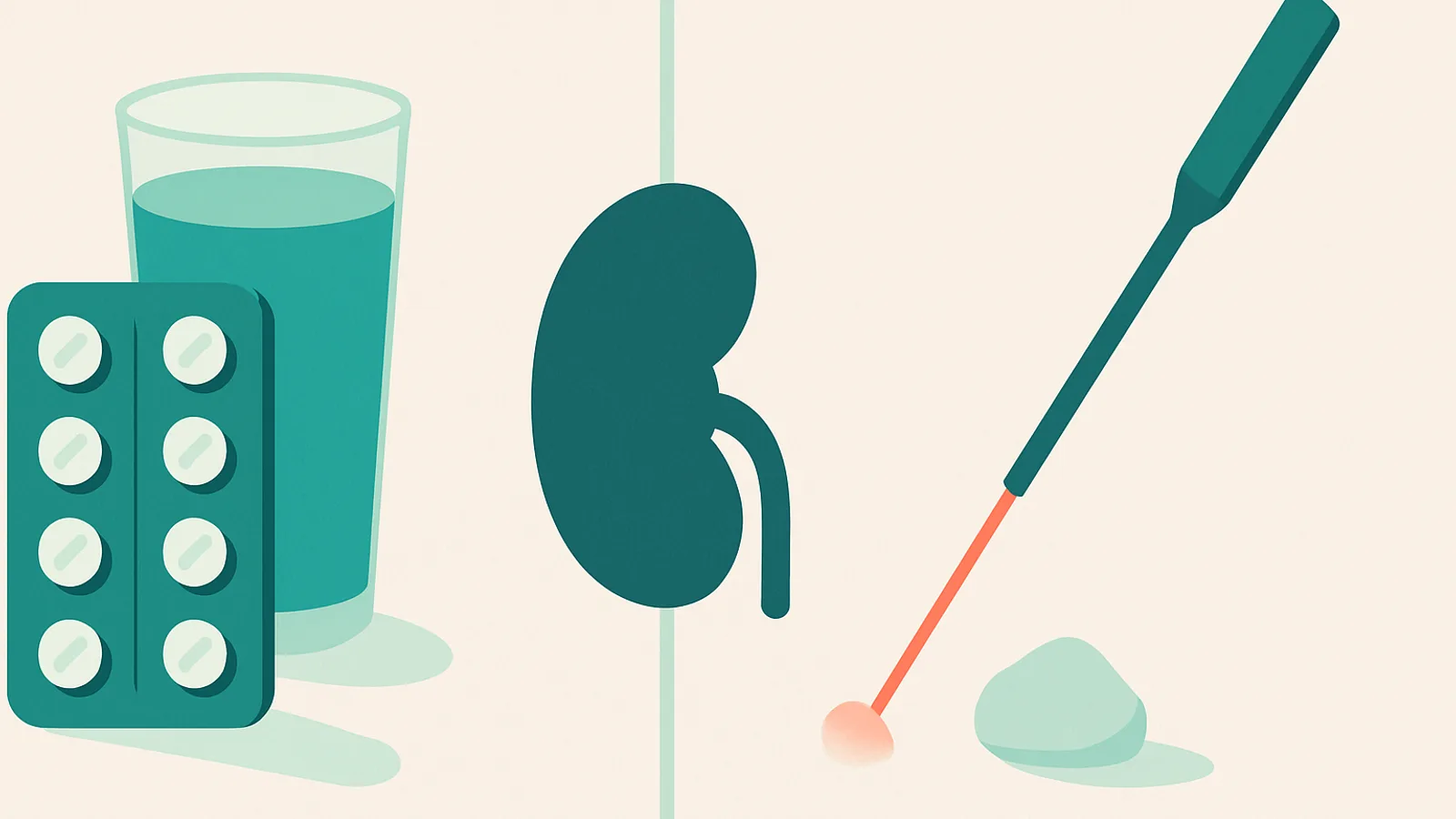
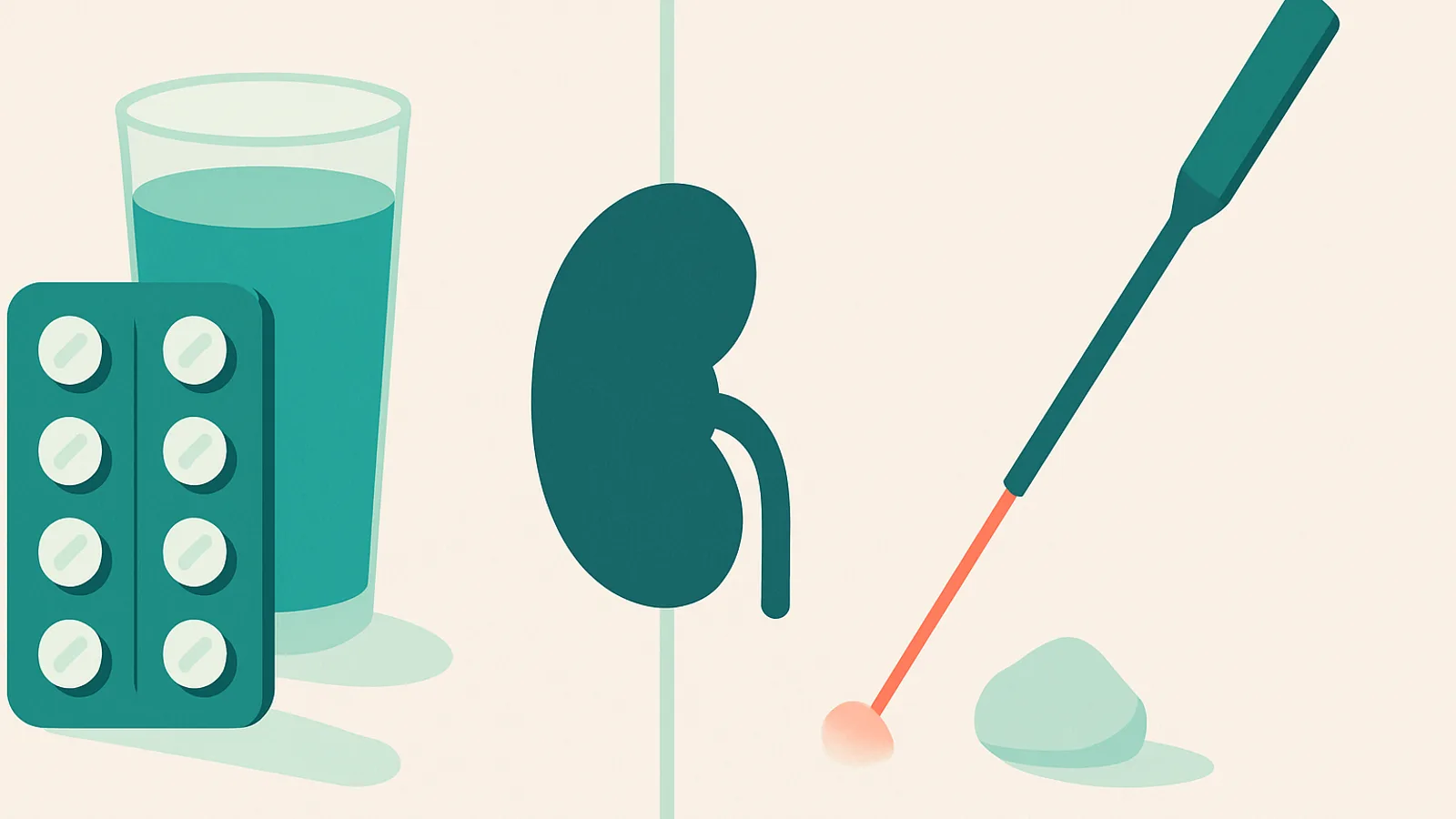
For a small stone with a reasonable chance of passing, treatment is medical rather than surgical. It usually combines:
Pain relief. Anti-inflammatory medicines work better than simple painkillers for stone colic, and your doctor will pick one that suits your kidney function.
Medical expulsive therapy. An alpha-blocker relaxes the muscle of the lower ureter, which helps a stone move down. It is not a magic tablet. It does improve the odds for stones in the lower third.
Anti-sickness medicine, if the pain is making you vomit — which it often does.
Fluids. Not litres forced down in one go, which does not help and can make pain worse during an obstruction. Steady, sensible intake through the day.
A word of caution: do not treat yourself with leftover tablets or a neighbour's prescription. Some common painkillers are hard on kidneys. The wrong one during an obstruction is a genuinely bad idea. Anti-inflammatories especially need a doctor's judgement if your kidney function is not normal.
Your doctor will usually give a trial of a few weeks. If the stone has not passed in that time, or the pain keeps returning, the plan changes.
When a procedure is needed
Medicine is not the answer when:
- The stone is too large to pass
- It is blocking urine and the kidney is under pressure
- There is infection behind the blockage
- Pain keeps recurring despite treatment
- Kidney function is being affected
- The stone has not moved after a reasonable trial
None of that means anything has gone wrong. It means the stone is one of the ones that was never going to pass.
The main procedures
Laser stone surgery (ureteroscopy). A thin scope passes up through the natural urinary passage — no cut, no external wound. A laser then breaks the stone into fragments small enough to pass. This is the most common approach for ureteric stones.
PCNL, for large stones in the kidney itself, through a small track in the back.
Shock wave lithotripsy (ESWL), which breaks stones from outside the body using focused waves. Suitable for some stones, not all.
Which one suits you depends on the stone, not on preference. The NIDDK's kidney stones resource and the NHS guidance on kidney stone treatment both describe these procedures in similar plain terms.
Laser surgery for kidney stones recovery time
This is the question people ask before they ask anything else, and the honest answer is that it is shorter than most expect.
Same day: most patients go home the same day or after one night, depending on timing and how the procedure went.
First two or three days: burning when passing urine, some blood in the urine, and a general ache. All expected.
Within a week: most people are back to desk work and ordinary routine.
Two to four weeks: physical work, heavy lifting and long driving, depending on what was done.
The limiting factor is usually not the procedure. It is the stent, if you were given one — and stent symptoms are what most people describe when they say recovery was uncomfortable. Our guide on how to sleep with a kidney stent covers that side of it properly.
Call the hospital the same day, during recovery, if you develop fever, heavy bleeding with clots, pain your medicine is not touching, or you cannot pass urine at all.
What the treatment involves at Saroj Hospital
Assessment is an ultrasound and a urine test, usually finished in the same visit. Our pathology laboratory is NABL-accredited, meaning its processes are independently audited, and most reports are ready the same day.
Dr. Jatin Jain, MBBS, DNB (General Surgery), MCh (Urology) sees patients in the urology OPD every day, 9:00–11:30 AM and 4:00–6:30 PM. An MCh in Urology is a super-specialty qualification, taken after general surgery training. That is worth knowing when you decide where to have a stone dealt with.
Bring any previous scans and reports. If you have passed a stone before and kept it, bring that too — knowing its composition changes the advice on preventing the next one, which is the whole point of our 7 day kidney stone diet chart.
Frequently asked questions
Can medicine dissolve a kidney stone?
Only uric acid stones, and only on prescribed medicine that makes urine less acidic, taken under supervision. Calcium oxalate stones — around four in five — cannot be dissolved. Anything sold as a general stone-dissolving remedy is not doing what it claims.
How much does kidney stone removal cost?
That depends on the procedure, the length of stay and what your stone needs, so we do not publish a figure that could be wrong by the time you read it. Tap Book or call reception and you will get the actual number for your situation, along with a slot.
Is laser stone surgery painful?
The procedure is done under anaesthesia, so you feel nothing during it. Afterwards expect burning and an ache for a few days. Most of the discomfort people remember comes from the stent rather than the surgery.
Will my stone come back?
It might — recurrence after a first stone is common over the following years. That is exactly why diet, fluids and a stone analysis matter, and why the follow-up visit is worth keeping even when you feel completely well.
Book an appointment
If pain keeps returning, or a scan has shown a stone you have not had assessed, get it looked at rather than living on painkillers. Consultation, ultrasound and lab tests happen in one visit here.
Book an appointment with the urology OPD, or call reception on +91 96676 67011.
Medically reviewed by Dr. Jatin Jain, MBBS, DNB (General Surgery), MCh (Urology), Saroj Hospital, Sonipat.
This article is general health information, not medical advice. For guidance about your own health, please consult a doctor.
Consult Dr. Jatin Jain
Book a real slot online — confirmation is instant.