Your urologist has said the stone is not going to pass on its own. Now there are new words to learn: laser, RIRS, shock wave, lithotripsy. A relative swears by one, a neighbour by another, and you are not sure which questions to ask.
This guide compares the two treatments people ask about most: laser surgery for kidney stones and shock wave treatment. It explains how each works, which stones suit which, and what recovery looks like, so you can have a clear conversation with your doctor.
If you are still deciding whether a stone needs treatment at all, start with our guide to kidney stone size. For assessment, our urology department in Sonipat has ultrasound and the laboratory in the same building.
The two approaches at a glance
| Laser (ureteroscopy / RIRS) | Shock wave (ESWL) | |
|---|---|---|
| How it works | A thin scope goes up the urinary passage; a laser breaks the stone | Focused waves from outside the body break the stone |
| Cut on the skin | None | None |
| Anaesthesia | Usually general or spinal | Often only pain relief or light sedation |
| Stones it suits | Stones in the ureter and many kidney stones, including hard ones | Smaller kidney stones, usually softer types |
| Stone cleared in one go | More often | Fragments pass over days to weeks; repeat sessions are common |
| Stent afterwards | Often, for a short time | Sometimes |
How laser surgery for kidney stones works
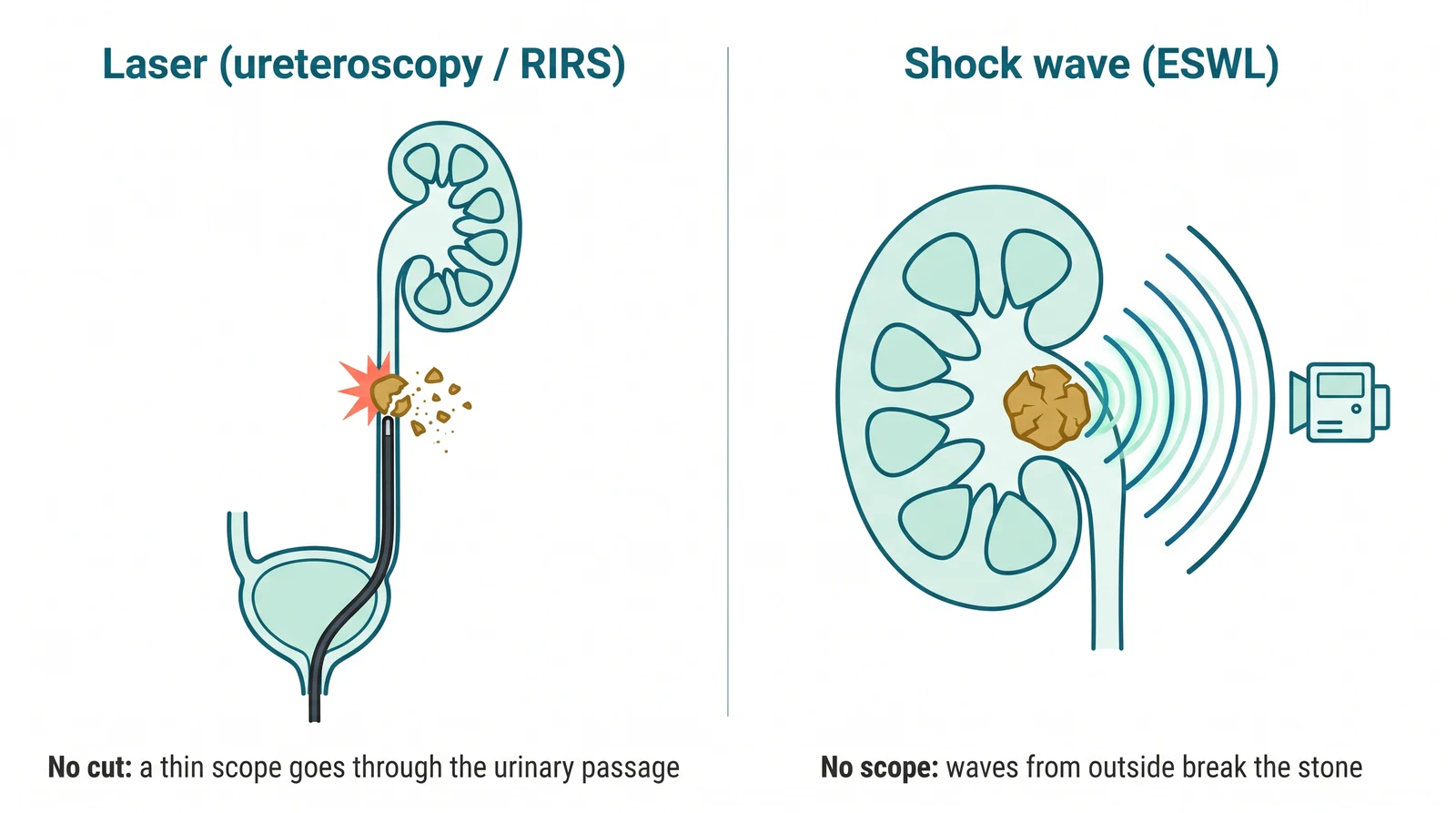
Laser treatment is done with a very thin telescope that passes through the natural urinary opening, into the bladder and up the ureter. No cut is made on the skin.
There are two main versions:
Ureteroscopy (URS or URSL) treats stones stuck in the ureter, the tube between the kidney and bladder. The surgeon reaches the stone and uses a laser to break it into dust or small pieces, which are removed or passed.
RIRS (retrograde intrarenal surgery) uses a flexible scope that bends to reach inside the kidney itself. It is used for kidney stones that are too large to pass but not large enough to need a bigger operation.
For very large kidney stones, usually above about 2 cm, a different procedure called PCNL is used. It goes through a small track in the back.
How shock wave treatment works
Shock wave lithotripsy for kidney stones, often called ESWL, uses focused sound waves from a machine outside the body. The waves pass through the skin and break the stone into small pieces. Those pieces then pass out in the urine over the following days or weeks.
Its big advantage is that nothing goes inside the body. It can often be done as a day procedure without general anaesthesia.
It does have limits. It works less well for:
- Hard stones, which some stone types are
- Larger stones, which may need several sessions
- Stones in the lower part of the kidney, where fragments struggle to drain out
- People with a larger build, as the waves have further to travel
It is not used in pregnancy, with an untreated urine infection, or with certain bleeding problems.
Which is right for your stone?
There is no single best option. The choice depends on:
- Size. Small kidney stones may suit either; larger ones usually suit laser or PCNL.
- Position. Stones in the ureter are usually treated with a laser.
- Hardness. Very hard stones respond poorly to shock waves.
- Your anatomy and health. Kidney shape, build, pregnancy and other conditions all matter.
- What matters to you. Some people prefer the best chance of clearing the stone in one go. Others prefer to avoid anaesthesia if they can.
Your urologist will look at your scans and explain why one option suits you better. The NIDDK guide to kidney stone treatment and the NHS guide to kidney stone treatment describe the same options and trade-offs.
Recovery after laser treatment
Recovery is usually quicker than people expect:
- Same day or next day: most patients go home.
- First few days: some burning when passing urine, a little blood in the urine and a dull ache are expected.
- Within a week: most people are back to desk work.
- Two to four weeks: heavy work and long drives, depending on what was done.
A small tube called a stent is often left in for a short time to help the kidney drain. For many people the stent is the most uncomfortable part. Our guide on how to sleep with a kidney stent covers how to manage it.
Call the hospital the same day if you develop fever, heavy bleeding with clots, pain your medicine does not touch, or you cannot pass urine.
Recovery after shock wave treatment
Most people go home the same day. Over the following days and weeks the fragments pass in the urine. This can cause some pain and blood in the urine as they move. A follow-up scan checks that the fragments have cleared, and a second session is sometimes needed.
Care at Saroj Hospital
Dr. Jatin Jain, MBBS, DNB (General Surgery), MCh (Urology) sees patients in the urology OPD every day, 9:00–11:30 AM and 4:00–6:30 PM.
His surgical practice includes URSL, RIRS and PCNL for kidney stones. He will explain which approach suits your stone and why. If shock wave treatment would suit your stone better, he will tell you so and explain where it can be done. Our article on kidney stones treatment medicine covers the options before surgery.
Frequently asked questions
Is laser surgery for kidney stones painful?
The procedure is done under anaesthesia, so you feel nothing during it. Afterwards, expect burning and an ache for a few days. Much of the discomfort people remember comes from the stent, not the laser.
Is RIRS better than shock wave treatment?
Neither is better for every stone. RIRS clears more stones in a single session, especially hard ones, but needs anaesthesia. Shock wave treatment avoids a scope but may need repeat sessions. Your stone's size, position and hardness decide.
Will I need a stent after laser treatment?
Often, for a short time, to help the kidney drain while swelling settles. It is usually removed in a quick follow-up visit. Your urologist will tell you how long it stays.
Can a kidney stone come back after laser surgery?
Yes, new stones can form over the years. Drinking enough water, eating less salt and following the advice from your stone analysis lower the chance. Keep your follow-up visits.
Book an appointment
If you have been told a stone needs treatment, book a consultation to understand your options. The scans, tests and urologist are all under one roof.
Book an appointment with the urology OPD, or call reception on +91 96676 67011.
Medically reviewed by Dr. Jatin Jain, MBBS, DNB (General Surgery), MCh (Urology), Saroj Hospital, Sonipat.
This article is general health information, not medical advice. For guidance about your own health, please consult a doctor.
Consult Dr. Jatin Jain
Book a real slot online — confirmation is instant.